
Employee giving platforms give a company one place to run payroll giving, matching gifts, volunteer grants, and giving campaigns. Employees choose the nonprofits, and the software handles receipts, match calculations, and payouts.
We compared nine employee giving platforms on features, pricing, reviews, and implementation effort, so you can build a shortlist that fits your company’s size and the programs you plan to run.
Disclosure: Uncommon Giving publishes this comparison and is one of the nine platforms. Every entry, including ours, is held to the same criteria and lists its limitations.
Key takeaways on employee giving platforms
- Only four of the nine employee giving platforms here publish a starting price. The rest quote through sales.
- Total cost has three parts: the annual platform fee, the implementation fee, and any fee taken from each donation. Vendors split them differently, so ask for all three.
- Implementation ranges from a launch measured in days to engagements of four or five months.
- Giving accounts built on donor-advised funds let employees keep their account when they change jobs. Not every platform offers one.
- If you plan to run corporate grants too, check whether grants live on the same platform or need a separate product.
On this page
- What is an employee giving platform?
- How we evaluated these platforms
- Employee giving platforms compared
- The 9 platforms, one by one
- How to choose an employee giving platform
- How to implement an employee giving platform
- Frequently asked questions
- Amplify your impact with the right employee giving platform
What is an employee giving platform?
An employee giving platform is the system a company uses to run and track its giving programs. Some vendors call it corporate giving software or corporate philanthropy software.
A platform gives employees one place to donate, request matches, and log volunteer hours. It also gives administrators the records they need to track participation and report on the company’s corporate social responsibility (CSR) program. To see how one works in practice, look at our employee giving software.

Essential features of an employee giving platform
These are the core capabilities a workplace giving program needs to run day to day.
- Employee giving: payroll deductions, one-time gifts, and employer-funded accounts employees use to donate
- Matching gifts: automated employer matches based on rules the administrator sets once
- Volunteer management: posting opportunities, tracking sign-ups, and logging hours in one system
- Volunteer grants: cash donations to nonprofits where employees have volunteered
- Mobile access: an employee experience that works on a phone
- Reporting: dashboards and exports covering participation, giving totals, match spend, and volunteer hours
What giving models do employee giving platforms support?
Platforms offer different ways for employees to take part. The popular options:
- Matching gifts: the employer matches employee donations, usually 1:1 up to an annual cap
- Payroll giving: recurring payroll deductions directed to nonprofits or a giving account
- Employer giving grants: company-funded deposits into employee accounts for milestones or campaigns
- Volunteer grants: also called Dollars for Doers, the company donates to nonprofits where employees volunteer
- Campaigns and giving days: time-bound giving drives, often with a live employer match
- Points to donations: employees convert recognition points into charitable gifts
How we evaluated these employee giving platforms
Objectivity was the priority. Every entry, including Uncommon Giving’s, was assessed against the same five criteria and carries at least one stated limitation.
- Ratings and review volume: G2 and Capterra ratings with review counts, checked in September 2026
- Pricing transparency: published pricing, fee schedules, and vendor calculators
- Giving models covered: matching, payroll giving, volunteer grants, campaigns, and grants management
- Implementation effort: reported launch times and whether a professional services engagement is typical
- Fit by company size: the headcount and team structure each platform serves best
When a vendor does not publish pricing or implementation figures, the estimates come from Uncommon Giving’s own comparison research and are labeled as estimates.
Employee giving platforms compared
The table compares the nine platforms on fit, pricing, ratings, key differentiator, and main watch-out.
| Platform | Best for | Pricing | Ratings | Key differentiator | Watch out for |
| Uncommon Giving (publisher) | CSR teams wanting portable giving accounts and a fast self-serve launch | From $5,000 a year for giving and volunteering, $2,400 a year for grants, implementation from $0 | 4.9/5 Capterra (18 reviews) | Portable donor-advised fund (DAF) giving account, plus giving, matching, volunteering, campaigns, and grants on one login | Smaller review base; narrower currency coverage than enterprise suites |
| Benevity | Fortune 500 enterprises with dedicated CSR teams | Scoped by module through sales, not published | 4.7/5 G2, 3.4/5 Capterra | 2.5M+ nonprofit database and deep enterprise integrations | About four-month average implementation; no published disbursement service-level agreement (SLA) |
| Selflessly | Companies under 500 employees wanting published pricing | From $249 a month (Starter), $669 a month (Growth), Enterprise custom | 4.8/5 G2 (47), 4.6/5 Capterra (15) | Published pricing with no module gating | Best fit tops out around 500 employees |
| Bonterra | Corporate foundations running complex grant programs | Enterprise, not published | 4.1/5 G2 (15) | Full grantmaking lifecycle engine | Employee tools came with the March 2026 Deed acquisition, so the combined product is new |
| Givinga | Companies wanting DAF infrastructure through a charitable foundation | Not published | 4.3/5 G2 (2) | Integrated charitable foundation reduces intermediary processing | Two G2 reviews of third-party feedback |
| Groundswell | Teams prioritizing payout speed and donor privacy | $8,500 a year Giving + Matching; $12,500 a year with volunteering | 4.9/5 G2 (101) | Published 24-hour distribution timeline and admin-blind cause privacy | Narrower international coverage (about 300,000 organizations) |
| Millie | Growth-stage companies wanting a gamified experience | About $9,101 a year at 100 employees (calculator), modules priced separately | 4.8/5 G2 (184) | “Giving Madness” bracket-style campaigns | Cost rises with headcount and modules |
| Submittable | Companies wanting grants, giving, and volunteering with a large database | Not published | 4.5/5 G2 (168) | 9.6M+ vetted nonprofits across 110 countries | No published pricing for corporate giving |
| YourCause (Blackbaud) | Enterprises in the Blackbaud ecosystem wanting a dedicated customer success manager | Estimated $35,000 to $100,000+ a year plus about $15,000+ setup | 4.2/5 G2 (47), about 3.8/5 Capterra | Blackbaud Verified Network (1.65M+ organizations) and Impact Edge analytics | About five-month implementation |

Which employee giving platforms publish a price?
Four of the nine publish a starting price for giving, matching, and volunteering: Selflessly, Uncommon Giving, Millie, and Groundswell.
The 9 employee giving platforms, one by one
1. Uncommon Giving: best for a fast self-serve launch with portable giving accounts
Uncommon Giving runs employee giving, matching, volunteering, campaigns, and corporate grants management on one platform, so all of your reporting data sits in one place.

Best for: companies of 100 to 10,000 employees that want giving, volunteering, and grants on one login with a published price.
Key features
- A personal donor-advised fund for each employee, one of its charitable giving accounts, that stays with the employee after they leave the company
- Matching rules (ratios, caps, and eligible nonprofits) set once by the administrator, plus matching gift auto-submission through Double the Donation
- A vetted database of more than 1.8 million nonprofits that the platform keeps current without manual work from your team
- Dollars for Doers volunteer grants
- Slack-native giving campaigns
- A grants management module with a locked scoring rubric and budget pools, on the same platform as employee giving
What we like
- Giving and volunteering programs can launch in as quick as 48 hours, and grants programs take about two weeks. Administrators configure the platform themselves with no professional services engagement.
- Grants, matched gifts, and volunteer hours for a given nonprofit resolve to one record, so a single report covers all three.
- Omatic Software said the platform “has improved the administrative side of our philanthropic program, as well as the employee experience.”
Watch out for
- Currency coverage is narrower than enterprise suites such as YourCause, which supports 170+ currencies.
- Its review base (18 Capterra reviews) is smaller than those of Millie or Submittable.
Pricing: Employee giving and volunteering starts at $5,000 a year, an annual program fee that grows with headcount, with no per-seat charge.
Grants pricing: metered on annual grant dollars. Starter is $2,400 a year for up to $250,000 in grants, Core is $4,800 a year for up to $1 million, Scale is $12,000 a year for up to $5 million, and Enterprise is priced through sales.
Fees: donations disbursed through employee giving carry a 2% fee, capped at $100 per disbursement. Uncommon Giving takes 0% of grant dollars disbursed.
Disbursement: continuously throughout the week and on demand.
Details: see the pricing page.
2. Benevity: best for global enterprise CSR programs
Benevity is an enterprise corporate purpose platform sold as four modules (Donate, Volunteer, Grants Management, and Employee Mobilization), each scoped and quoted separately. It also extends giving to customers through donation widgets and branded public giving sites.

Best for: Fortune 500 enterprises running programs across many countries with a dedicated CSR team.
Key features
- A database of 2.5M+ vetted global nonprofits
- Automated matching gifts, volunteer grants, in-kind donations, and employee-created volunteer events
- Customer giving through website donation widgets and branded giving sites
- Enterprise integrations and compliance infrastructure for programs spanning many countries
What we like
- Benevity’s brand is well known across Fortune 500 human resources (HR) and CSR teams, and its reporting is built for complex environmental, social, and governance (ESG) disclosure requirements.
- Its annual State of Corporate Purpose research is widely cited and adds to its credibility with CSR teams.
Watch out for
- G2 reviewers report an average implementation period of four months, typically with a professional services engagement.
- Benevity’s site says donations are “typically” disbursed in 14 to 21 days, with no published SLA, and several reviews describe longer delays.
- Customer service scores 2.9/5 on Capterra.
Pricing: platform fee scoped through sales based on employee count, countries, disbursement volume, and compliance needs. See our Benevity pricing breakdown.
Fees: the published fee schedule deducts a 2.99% cause support fee (capped at $500 per donation) plus merchant fees on card donations.
3. Selflessly: best for small companies wanting published pricing
Selflessly is a workplace giving platform that manages payroll giving, volunteering, matching, and impact reporting in one place. It also gives employees the records they need at tax time.

Best for: companies with fewer than 500 employees that want one monthly price with every feature included.
Key features
- Payroll deductions and recurring gifts
- Automated matching gift programs with auto-submitted match requests
- Volunteer activities that administrators create and share with employees
- Real-time impact metrics and reporting
What we like
- Every feature is included at the published price, so a small team can budget for the full platform without negotiating modules.
- The combined review signal across G2 and Capterra is strong for a platform of its size.
Watch out for
- Best fit tops out around 500 employees, so a fast-growing company may outgrow it.
- Its review base (47 on G2, 15 on Capterra) is smaller than those of Millie or Submittable.
Pricing: Starter is $249 a month for up to 100 employees with all features included. Growth is $669 a month for 100 to 500 employees, plus a $1,500 to $3,500 implementation fee. Enterprise is custom.
4. Bonterra: best for corporate foundation grantmaking
Bonterra Corporate Social Responsibility, previously known as CyberGrants, handles grantmaking, employee giving, and volunteering as part of a broader social good software portfolio. In March 2026, Bonterra acquired Deed, a workplace giving and volunteering platform, to pair Deed’s employee tools with its grantmaking software.

Best for: companies where a corporate foundation’s grantmaking sits at the center of the program.
Key features
- Full grantmaking lifecycle management covering applications, eligibility, review, disbursement, and reporting
- Several employee giving methods, including credit card giving and recurring payroll deductions
- Volunteering leaderboards and impact dashboards
- Optional add-ons such as a DAF and advanced support consulting
What we like
- One vendor relationship can span grants management, corporate giving, nonprofit CRM (constituent relationship management), and advocacy, which suits companies that manage social impact technology centrally.
- The Deed acquisition adds a dedicated employee giving and volunteering product to Bonterra’s grantmaking tools.
Watch out for
- The platform was assembled through acquisitions, most recently Deed in March 2026, so its employee giving tools and grantmaking core have a short history as one product.
- Some G2 reviewers say the interface isn’t intuitive.
Pricing: not published. See how it compares on our Bonterra alternatives page.
5. Givinga: best for foundation-backed DAF infrastructure
Givinga is a workplace giving platform built on an integrated charitable foundation and a DAF-based architecture.

Best for: companies whose finance or legal team prefers a charitable foundation model for governance or tax reasons.
Key features
- Integration with existing employee benefit systems
- A customizable dashboard for managing all charitable activity
- Real-time reports and company-branded donation receipts
- A dedicated client success manager, called a Philanthropic Advocate, for each customer
What we like
- Pairing the platform with its own charitable foundation removes some of the intermediary processing that slows donations elsewhere.
- The DAF-based design gives employees an account to hold and grant from over time.
Watch out for
- Two G2 reviews make independent validation difficult.
- Givinga’s market presence and content footprint are narrower than those of Benevity or Blackbaud.
Pricing: not published.
6. Groundswell: best for fast payouts and donor privacy
Groundswell pairs DAF-based giving accounts with a 24-hour distribution timeline, published on its pricing page, and a privacy model that keeps each employee’s charity choices hidden from administrators.

Best for: teams that put disbursement speed and employee privacy first.
Key features
- A published 24-hour distribution timeline for domestic donations and matches
- Admin-blind privacy that keeps each employee’s individual charity choices hidden from administrators
- Self-service setup with no professional services dependency
What we like
- Its published 24-hour timeline is the fastest payout commitment among the platforms here.
- Keeping individual charity choices out of admin view removes friction for employees who give to religious, political, or personal causes.
- A 4.9/5 rating across 101 G2 reviews is a strong signal at that volume.
Watch out for
- It covers more than 1.5 million U.S. nonprofits, but its international coverage of about 300,000 organizations (every registered charity in the UK, Canada, and Australia, plus organizations in 83 other countries) is narrower than that of enterprise platforms.
- Grants management is a separate product that starts at $25,000 a year.
- Above the two published tiers, the Enterprise tier is priced through sales.
Pricing: Giving + Matching is $8,500 a year, Giving + Matching + Volunteering is $12,500 a year, and Enterprise is priced through sales.
Fees: a 1% distribution fee on domestic donations (waived on recurring gifts) and 3% on international donations.
Compare: Groundswell alternatives: Uncommon Giving compared.
7. Millie: best for gamified, campaign-driven giving
Millie is an employee giving platform with a design-forward interface and add-on modules for volunteering, groups, and payroll giving.

Best for: growth-stage companies that want campaign-driven engagement and can budget per employee.
Key features
- “Giving Madness,” a bracket-style campaign where teams compete on donations to lift participation across the company
- A design-forward employee interface
- Add-on modules for volunteering, groups, and payroll giving
What we like
- Millie’s campaign formats give CSR teams a ready-made way to build participation, and the interface is approachable for employees giving for the first time.
- Its 184 G2 reviews are the largest review base on this list.
Watch out for
- Per-employee pricing plus separately priced modules means cost rises as headcount grows.
- Implementation takes three to four weeks.
- No DAF-based portable giving account, and grants management requires a separate custom proposal.
Pricing: priced per employee, plus optional modules. Millie’s calculator gave these estimates for donations, volunteering, and payroll combined: $9,101 a year at 100 employees, $18,262 at 500, and $26,424 at 1,000. Grants pricing is not published. See the Millie comparison.
8. Submittable: best for large international nonprofit coverage
Submittable offers a corporate giving platform that combines grants, employee giving, and volunteering, backed by a database of 9.6M+ vetted nonprofits.
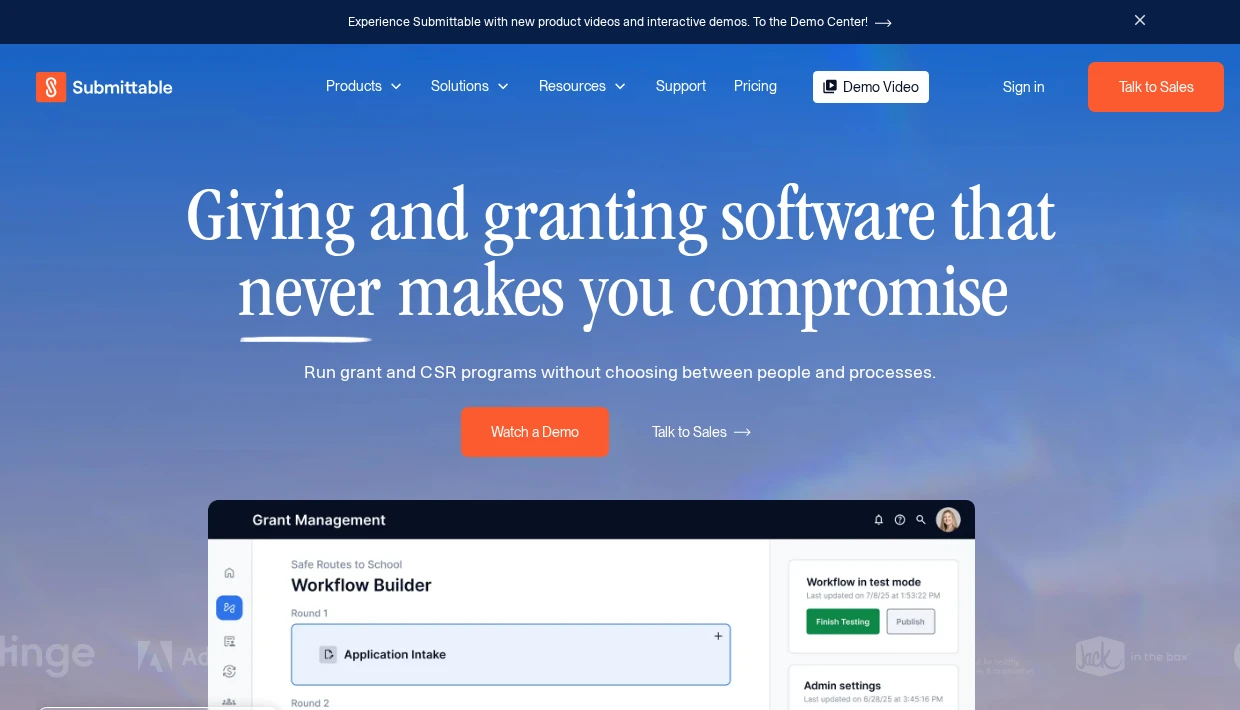
Best for: companies whose employees give outside the U.S. and who want grants alongside giving.
Key features
- 9.6M+ vetted nonprofits across 110 countries
- Grants management, employee giving, and volunteering in one product
- A structured grant application and review process
What we like
- The nonprofit database is the largest on this list and reaches the widest range of countries.
- A 4.5/5 rating across 168 G2 reviews gives buyers a solid volume of independent feedback.
- Community investment options include disaster relief and scholarships.
Watch out for
- Submittable publishes no pricing on its corporate giving page, so a cost comparison takes a sales conversation before a shortlist is final.
Pricing: not published. For grants-specific options, see alternatives to Submittable for corporate grants.
9. YourCause: best for organizations in the Blackbaud ecosystem
YourCause is Blackbaud’s enterprise workplace giving product, positioned as an extension of Blackbaud’s nonprofit software ecosystem.

Best for: organizations already running on Blackbaud that value a dedicated customer success manager.
Key features
- The Blackbaud Verified Network of 1.65M+ organizations
- Impact Edge analytics for compliance-grade reporting
- A dedicated customer success manager
- Support for 170+ currencies
What we like
- Companies already using Blackbaud products get integration breadth that standalone giving platforms can’t match.
- The currency coverage and reporting depth suit enterprise programs with formal compliance requirements.
Watch out for
- Implementation runs about five months.
- Administrators work across three different modules.
Pricing: not published. Our estimate is roughly $35,000 to $100,000+ a year, plus a setup fee of about $15,000 or more. See the YourCause comparison.
Reviews: 4.2/5 on G2 (47 reviews) and about 3.8/5 on Capterra.

How to choose an employee giving platform
Start with headcount and how much administration your team can take on. Then filter by the giving models you plan to run and the price transparency your finance team needs. Finance leaders comparing total cost should ask each vendor for the annual platform fee, the implementation fee, and any per-donation processing fee, because the vendors on this list split cost across all three in different ways.
- Choose Uncommon Giving if your company has 100 to 10,000 employees, wants giving, volunteering, and grants on one login, and needs a published price your finance team can budget against.
- Choose Benevity if you run a program across many countries with a dedicated CSR team and can plan for an implementation measured in months.
- Choose Selflessly if you have fewer than 500 employees and want one monthly price with every feature included.
- Choose Bonterra if grantmaking by a corporate foundation sits at the center of your program.
- Choose Givinga if your finance or legal team prefers a charitable foundation model for governance or tax reasons.
- Choose Groundswell if disbursement speed and employee privacy are your top priorities.
- Choose Millie if campaign-driven engagement matters most and per-employee pricing fits your budget.
- Choose Submittable if broad international nonprofit coverage is a priority and you want grants alongside giving.
- Choose YourCause if your organization already runs on Blackbaud and values a dedicated customer success manager.
To put a number on what a program returns before you buy, try the return on investment (ROI) calculator.
How to implement an employee giving platform
Once your shortlist is set, these five steps take a platform from signed contract to active participation.

- Define goals and requirements. Assess your current giving and volunteering programs, decide which features you need most, and set the metrics you’ll track.
- Research platforms. Compare product pages, published pricing, and third-party reviews. Talk to peers in your industry who have already launched.
- Request demos. Run a real match rule, test a campaign, and watch a donation move through the system. Evaluate ease of use, security, integrations, and support.
- Train your team. Hold a short launch session and share quick guides covering everyday tasks for administrators and employees.
- Promote the program. Add the platform to onboarding materials, email newsletters, and your intranet. Make details easy to find, since 34% of employees wish their companies shared more about matching gift programs, according to Double the Donation.
Frequently asked questions about employee giving platforms
What are the benefits of workplace giving platforms?
Workplace giving platforms can support retention and employee well-being, and they give employees, customers, and investors a way to take part in a company’s giving. In Fidelity Charitable’s research, 35% of Millennial and Gen Z employees said giving programs factor into whether they stay at a job, and 84% of consumers, employees, and investors say they should be able to take part in a company’s giving, according to The NonProfit Times. For the financial case, see the free guide CSR by the Numbers.
Is an employee giving platform the same as a donor-advised fund?
No. A donor-advised fund is a tax-advantaged charitable account an individual contributes to, receives an immediate tax deduction for, and grants from over time. Some employee giving platforms, such as Uncommon Giving and Groundswell, build on DAF infrastructure so employees get a portable account they keep when they change jobs. Others send each donation straight to the nonprofit with no holding account.
What does CLMA certification mean for a matching gift program?
CLMA stands for Certified Leader in Matching Automation. Double the Donation awards it to CSR platforms that integrate with its matching tools to support matching gift auto-submission, so a donor can request a match without filling out a separate form. It does not certify match calculations or audit trails. Several platforms on this list hold it, including Uncommon Giving, Millie, Givinga, and Selflessly, so treat it as a screening check rather than a deciding factor.
How do employee giving platforms confirm a nonprofit is eligible?
Most platforms verify nonprofits automatically by checking Internal Revenue Service (IRS) 501(c)(3) records. The differences are how often that check runs and how many organizations the database covers. Ask each vendor how quickly a revoked status reaches its system, because that lag decides whether a match can go to an ineligible organization.
Should giving and volunteering run on the same platform?
Running both on one platform tends to produce better results. Blackbaud’s CSR industry research found 11.7% employee engagement when giving and volunteering run together, compared with 4.5% for giving-only programs, as covered in our 2026 social impact trends post. A single platform also lets volunteer hours convert to grants without re-entering data and gives leadership one report covering both.
What are the trends in workplace giving?
Corporate giving grew 3.1% to $43.67 billion in 2025, according to Giving USA 2026. Smaller companies also see higher participation: companies with fewer than 10,000 employees had a 31% volunteer participation rate, compared with 16% at companies with more than 100,000 employees, according to CECP’s (Chief Executives for Corporate Purpose) Giving in Numbers 2025 edition. And disaster and international aid nonprofits posted the highest revenue increase in M+R’s Benchmarks data, as more companies use their giving platforms to respond to global events.
Amplify your impact with the right employee giving platform
Among major U.S. corporations, 94% plan to maintain or increase their charitable giving in the next few years, according to Double the Donation’s 360MatchPro research. As more companies invest in giving programs, choosing the right employee giving platform can matter as much as the programs themselves.
Uncommon Giving runs employee giving, matching, volunteering, campaigns, and grants management on one platform with one login. Every employee gets a portable giving account they keep when they change jobs, and the platform is self-serve with published pricing your finance team can budget against. Employee giving and volunteering starts at $5,000 a year and can launch in as quick as 48 hours; grants management starts at $2,400 a year, and a grants program takes about two weeks.
Book a demo to see it run your own matching rules.