

Benevity doesn't publish pricing. There's no pricing page, no self-service tier, and no free trial, and the platform prices each deployment on several factors, so the only path to a number runs through a sales conversation. Most buyers are trying to work out two things: whether the platform's capabilities justify the cost, and whether the implementation model fits their company's size and structure.
This post breaks down what Benevity charges, what shows up after the contract is signed, where the platform performs well and where it frustrates admins, and when a different option might fit you better.
Key takeaways
- Benevity prices every deployment through direct sales, scaled to employee count and selected modules, with no published rate card.
- Beyond the platform fee, Benevity deducts a 2.99% cause support fee plus merchant fees from every donation, and charges separately for custom reports, program reviews, and off-cycle disbursements.
- The Grants module is licensed on its own track, separate from Giving and Volunteering, and carries the heaviest implementation load of any module.
- Fit is strongest above roughly 10,000 employees with a dedicated CSR team and multinational compliance needs.
- Uncommon Giving is a self-serve workplace giving platform for corporate teams. Subscriptions start at $5,000 per year, implementation starts at $0, launch can happen in as quick as 48 hours, and there is no per-request billing.
On this page
- How we sourced Benevity pricing data
- Benevity overview
- How much does Benevity cost?
- Where Benevity creates friction for buyers
- Who should use Benevity?
- A self-serve alternative for corporate teams
- Frequently asked questions
How we sourced Benevity pricing data
Benevity doesn't publish platform subscription rates. The donation-side fees in this article come from Benevity's own Foundations Fees Schedule, last updated May 1, 2026. That schedule is the most detailed public source Benevity makes available, and it covers cause support fees, merchant fees, foreign exchange markups, and check processing charges.
Review scores come from Capterra and Software Advice. Implementation timelines come from G2 reviews.
Benevity overview
Benevity is a corporate social impact platform that helps companies manage employee giving, volunteering, and grantmaking programs. It is sold as five separately licensed and priced modules:
- Giving. Employee donations, matching, and payroll deductions.
- Volunteering. Event coordination, hour tracking, and volunteer grants.
- Grants. Corporate grantmaking with application workflows, eligibility rules, and compliance reporting.
- Campaigns. Disaster relief, themed giving events, and micro-actions.
- Impact Reporting. Dashboards and data on program participation and outcomes.

Where Benevity performs well
Before getting into cost, it's worth being clear about where Benevity earns its reputation:
- $15 billion or more in cumulative donations processed across 200+ countries.
- A 99% payment efficiency rate, which reflects how reliably that global infrastructure works at scale.
- Workday integration and certified match processing, giving multinational companies the connectivity their HR systems need.
- Over 2 million vetted nonprofits, so employees have a broad network to direct their giving to.
How much does Benevity cost?
Benevity's costs split into two tracks. One set of fees is deducted from donations before nonprofits receive them. The other is what employers pay for the platform itself. Both matter when you're sizing up total program cost, and they show up in different places.
Fees deducted from donations
While the platform subscription is negotiated privately, Benevity does publish a fee schedule covering the charges deducted from donations before nonprofits receive them:
- Cause support fee. 2.99% of each donation, capped at $500 USD per donation. The rate may differ based on a client's master agreement, so ask for your specific rate in writing. The cap does not apply to matching transactions or gifts of securities, so the full 2.99% is charged on the matched portion and on securities.
- Merchant fees. Credit and debit card donations through the U.S. foundation (AOGF) carry a 2.95% payment processing fee. Other foundations charge 2.75% for cards (1.50% in Australia). PayPal fees vary by donor country and range from 1.10% to 5.40% plus a fixed fee.
- Foreign exchange fee. A 1.50% markup on the exchange rate applies when donations are converted from one currency to another at disbursement. Some currencies carry higher rates.
- Manual check fee. When a nonprofit has not enabled electronic payment, the fee is $35 or 8% of the check amount, whichever is greater, capped at $125. The first two checks to a cause are free, to give the nonprofit time to set up electronic disbursement.
- Minimum check threshold. Donations to a cause must reach at least $100 before a check is sent. Amounts below $100 but above $20 are swept and disbursed approximately once a year. Amounts below $20 may be rejected entirely, and the donor may be asked to redirect to another cause.
Consider a U.S. employee donating $100 by credit card. The published deductions alone total roughly $5.94 (the 2.99% cause support fee plus the 2.95% merchant fee), before any foreign exchange or check fees apply. At scale, those percentages become a material factor in how much of your program's giving actually reaches nonprofits.
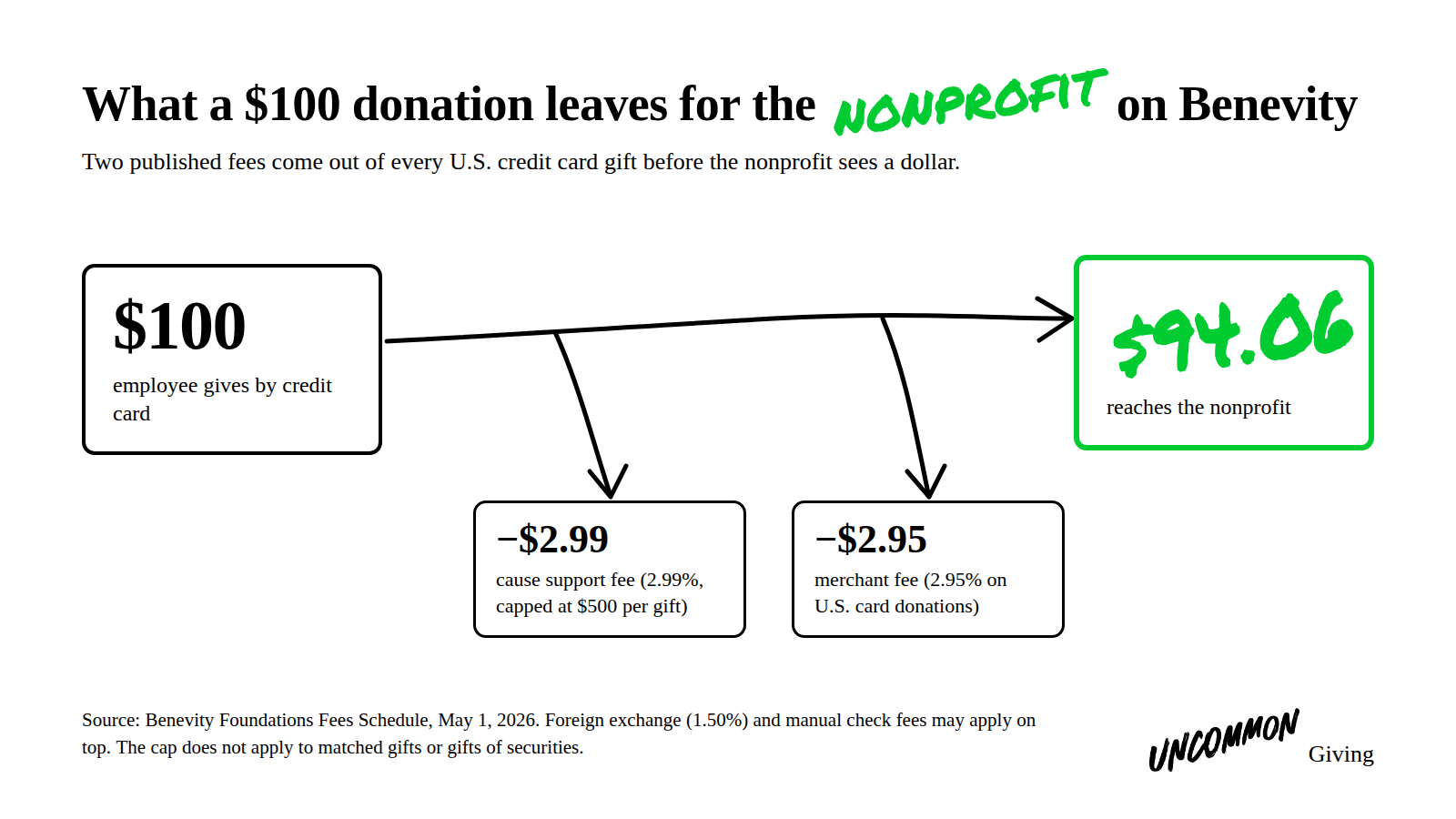
One note: these fees reduce what the nonprofit receives, not what the employer pays, unless the employer elects to cover them. They don't reduce the donation amount on any tax documentation issued to donors.
What employers pay for Benevity
Employer-side costs are separate from the donation fees above, and none of them are published.
- Platform subscription. An annual fee scaled to headcount and modules. There's no published rate, and every module (Giving, Volunteering, Grants, and the rest) is priced separately.
- Per-request charges. Buyers report that custom reports, program reviews, and off-cycle disbursements each carry separate charges on top of the base subscription.
- Annual escalation. Multi-year contracts may include built-in annual price increases. Ask for the escalation clause and the specific percentage before signing.
- Implementation costs. Implementation can take several months. That carries real cost in internal staff hours and a delayed program launch, well beyond any onboarding fee.
- Individual module fees. The Grants module, for example, is priced separately from Giving and Volunteering, not bundled. Configuration requires significant internal staff time before the first grant cycle can run, so price it as license cost plus headcount.
Calculating your total Benevity costs
Because Benevity does not publish a rate card, the most useful thing this article can do is give you a framework to price the platform against your own numbers. Before a discovery call, gather these figures:
| Cost | What to ask or estimate |
| Platform fee | Request the annual fee for your headcount and the specific modules you need. Get Giving, Volunteering, and Grants quoted separately. |
| Cause support fee and merchant fees | The published cause support fee is 2.99% per donation (it may differ under your agreement). Merchant fees add 2.95% on U.S. card donations. Multiply the combined rate by your expected annual donation volume, including the uncapped fee on matching, to see the total deducted from what nonprofits receive. |
| Implementation | Ask for the onboarding fee, the estimated timeline in weeks, and how many internal staff hours the buildout requires. |
| Per-request charges | Ask which requests are included in your subscription (custom reports, program reviews, off-cycle disbursements) and which generate a separate invoice. |
| Annual escalation | Ask whether the contract includes a built-in annual increase, and at what percentage. |
| Year-one total | Sum all five layers. Compare that figure to your CSR program budget, not just the platform-fee line your rep quotes. |
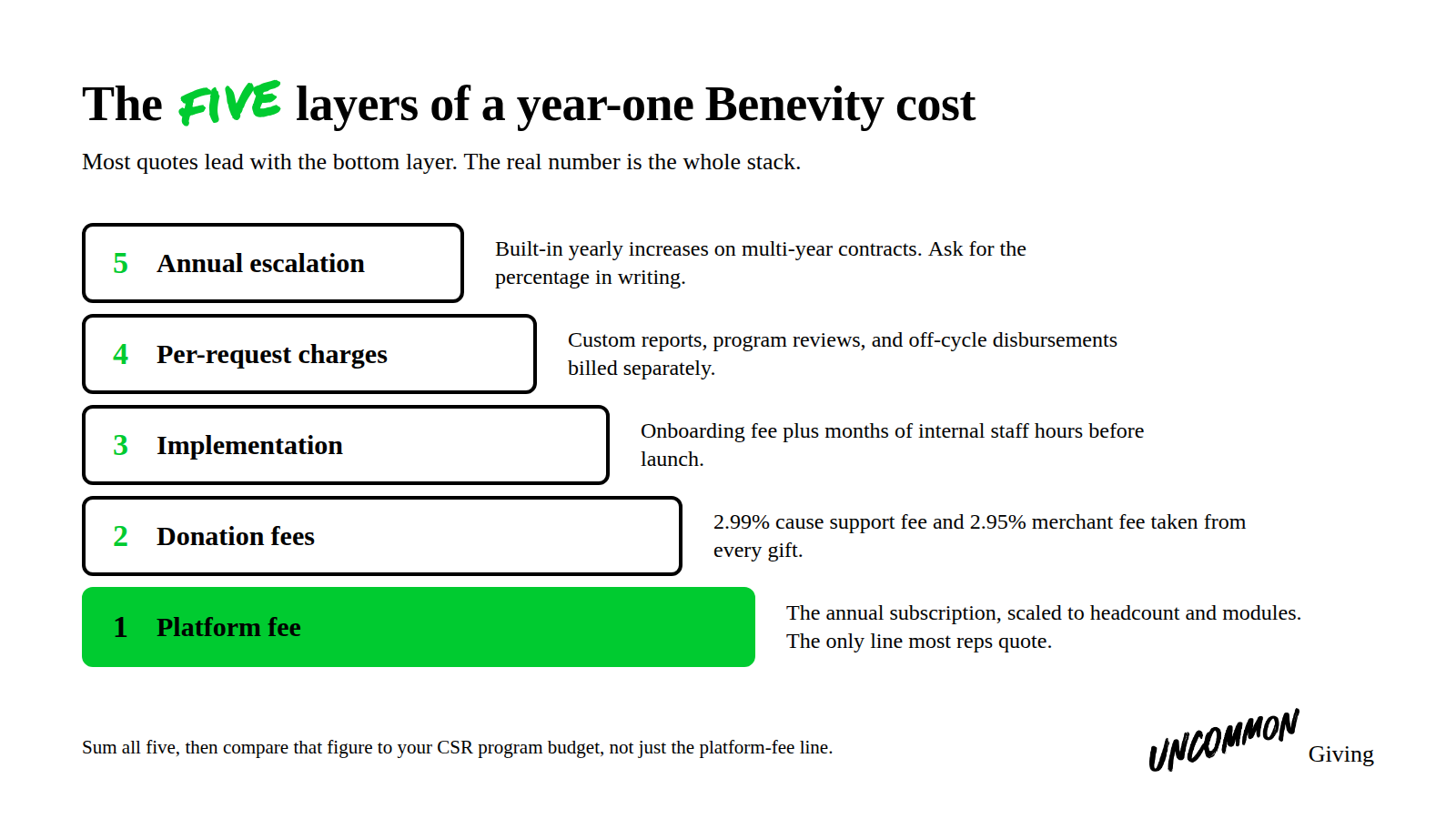
Most buyer surprises happen in the gap between the quoted platform fee and what the first year actually costs. If your finance team only prices the subscription, the real number will be higher. Our ROI calculator is a quick way to model the program side of that math with your own headcount and participation assumptions.
Where Benevity creates friction for buyers
Benevity's review scores on Capterra and Software Advice fall below what most buyers expect from a platform at this price point.
| Source | Metric | Score |
| Capterra | Overall rating | 3.4 / 5 |
| Capterra | Customer service | 2.9 / 5 |
| Capterra | Features | 3.3 / 5 |
| Software Advice | Overall rating | 3.4 / 5 |
| Software Advice | Value for money | 3.0 / 5 |
| Software Advice | Customer support | 2.9 / 5 |
Reviewers point to a few recurring problems.
- Reporting requires multiple systems. Admins consistently cite navigation complexity, and many don't want to pull from separate reporting tools to assemble data that spans Giving, Volunteering, and Grants.
- Support favors larger accounts. Benevity's customer service scores 2.9 out of 5 on both Capterra and Software Advice, with multiple reviews citing a lack of transparency or communication. Smaller accounts report that responsiveness tracks contract size, with attention concentrating on the highest-value clients.
- Matched donations take months to reach nonprofits. Multiple customers report significant delays between an employee's gift and the nonprofit receiving matched funds, which works against the real-time impact visibility most CSR programs are trying to build.
Who should use Benevity?
Benevity is a strong option for companies with:
- 10,000 or more employees. The program management infrastructure earns its cost at that headcount.
- Multinational compliance requirements. Operations across many countries where local giving rules differ.
- A dedicated CSR team and implementation budget. Staff who can absorb a four-month onboarding.
- Deep enterprise HR integration needs. Workday-level connections into existing systems.
The fit weakens for companies with:
- Fewer than 10,000 employees. The enterprise design starts working against the buyer.
- No dedicated CSR function. The program lands on HR or People Ops alongside everything else.
- A near-term launch date. No appetite for a professional services engagement first.
- A finance team that wants predictable all-in pricing. Layered contracts with per-request billing complicate forecasting.
If that second list sounds like you, our guide to corporate giving software and our CSR software comparison cover the wider field of options, including Benevity.
Uncommon Giving: a self-serve alternative for corporate teams
Uncommon Giving was built for the buyer Benevity doesn't quite fit. Andy Howell, who leads Uncommon Giving, formerly worked at Benevity, where he saw firsthand how enterprise pricing, extended implementation cycles, and per-request billing created barriers for companies running leaner teams on tighter budgets.

Here's what that looks like in practice:
- Self-serve configuration. No professional services engagement required. Implementation starts at $0, and launch can happen in as quick as 48 hours, compared with the roughly four-month average G2 reviewers report for Benevity.
- Subscriptions starting at $5,000 per year. Employee giving and volunteering is priced as a flat annual program fee quoted by company size, with no per-request charges for custom reports or program reviews. Corporate grants management starts at $2,400 per year, with a 0% fee on grant dollars disbursed.
- Automated match processing with a full audit trail. Admins configure match ratios, per-employee caps, and eligible nonprofit criteria once, and the system applies those rules to every request without manual review. See how employee giving and matching works.
- 1.8M+ vetted nonprofits. Employees choose from a verified nonprofit network.
- Portable donor-advised fund wallets. Each employee gets a personal charitable giving account they keep when they change jobs. The giving relationship belongs to the employee, not the employer.
- Giving and volunteering on a single dashboard. Volunteering, matching, campaigns, and reporting live in one place, with HRIS, payroll, and SSO integrations for the systems you already run.
If you're early in the evaluation and want to see the numbers side by side, run your headcount through our ROI calculator, or read how teams like yours made the switch in our customer stories.
| Benevity | Uncommon Giving | |
| Pricing model | Custom, negotiated per deployment | Flat annual subscription, starting at $5,000 per year |
| Implementation | Can take several months | Starts at $0, live in as quick as 48 hours |
| Fee structure | Platform fee + cause support fee + per-request charges | Subscription, no per-request charges for reports or reviews |
| Giving architecture | Employer-anchored giving | Portable employee DAF wallet |
Frequently asked questions about Benevity pricing
Does Benevity offer a free trial?
No. Benevity does not offer a free trial or a self-service tier. Every deployment requires a sales conversation and a custom quote.
How much does Benevity cost per year?
Benevity doesn't publish annual rates, and every contract is negotiated through sales based on employee count and selected modules. On top of the platform fee, Benevity deducts a 2.99% cause support fee and a 2.95% merchant fee (for U.S. card donations) from each donation processed. Implementation, per-request charges, and annual escalation clauses add to the total.
Is there a cheaper alternative to Benevity?
Yes. Several alternatives serve companies of 10,000 employees and under at a lower price point. Uncommon Giving, for example, starts at $5,000 per year for employee giving and volunteering, with implementation starting at $0 and no per-request billing.
What fees does Benevity take out of each donation?
Benevity deducts several fees from each donation before it reaches the nonprofit:
- Cause support fee: 2.99% of each donation, capped at $500 per donation.
- Merchant fee: 2.95% on U.S. credit card donations. PayPal fees vary by donor country.
- Foreign exchange fee: 1.50% markup when donations are converted between currencies.
- Manual check fee: $35 or 8% (whichever is greater, capped at $125) for nonprofits that have not set up electronic payment. The first two checks are free.
Can a multi-year contract lower Benevity's price?
Multi-year terms could lower your Benevity quote. However, multi-year contracts may include annual escalation clauses, so ask for the escalation percentage in writing before signing.
What does the all-in cost look like for a 1,000-employee company?
Benevity doesn't publish rates, so no fixed number is available. Year-one cost includes the platform fee, implementation, the 2.99% cause support fee, the 2.95% merchant fee on card donations, and any per-request charges.
What is typically excluded from a Benevity quote?
Benevity quotes commonly exclude the Grants module, custom report fees, program review fees, off-cycle disbursement charges, and the donation-side fees that reduce what nonprofits receive.
How does Benevity pricing compare to Uncommon Giving?
Benevity's pricing is negotiated per deployment with layered fees on top of the platform subscription. Uncommon Giving charges a flat annual subscription starting at $5,000, with implementation starting at $0 and no per-request billing for reports or reviews. Launch can happen in as quick as 48 hours, compared with the roughly four-month average G2 reviewers report for Benevity. See the full platform comparison.
See what a flat-fee giving program looks like
If you've been quoted by Benevity and the year-one number came in higher than the platform fee suggested, you're not alone. Tell us your headcount, your budget, and whether matching and grants are in scope, and we'll tell you honestly whether Uncommon Giving is the right fit. Request a demo.
Related articles
- 11+ best CSR software for impact, engagement, and ROI. Twelve platforms compared on giving, volunteering, matching, and reporting, Benevity included.
- 10+ best corporate giving software for easy social impact. The wider field of platforms, with pricing and trade-offs for each.
- Donation matching for companies: a complete program guide. Ratios, caps, and policy design for a match program employees actually use.
- Employee and workplace giving: blueprint for modern companies. How to design a giving program from policy to launch.