
If your corporate or foundation giving program has outgrown Submittable, or a general-purpose submission platform doesn't cover the grants workflow your team actually runs, you're not alone. Most searches for Submittable alternatives start the same way: a program that launched fine and then hit a wall on pricing visibility, payout workflow, or the way employee giving and grants sit in two different systems.
This post covers what Submittable does well, where corporate CSR teams tend to hit friction, and five Submittable alternatives built specifically for grants and social impact programs. Uncommon Giving is one of the five, and our section gets the same treatment as every other option.
Key takeaways
- Submittable is a capable grants and CSR platform, but it serves three different buyer types (government, foundations, and corporations) on the same product.
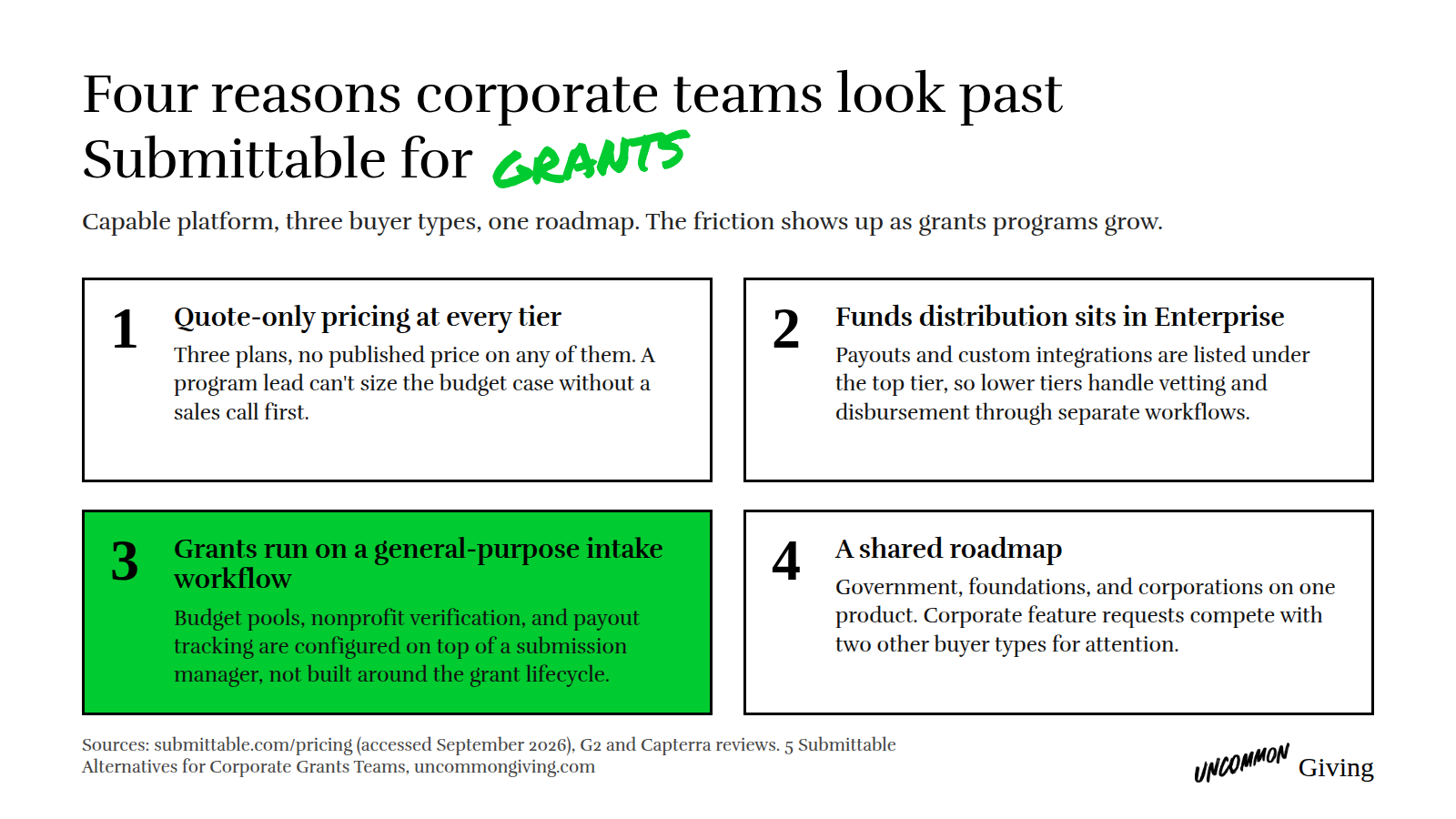
- Four friction points push corporate teams to look at Submittable alternatives: quote-only pricing at every tier, funds distribution gated to Enterprise, no portable employee giving accounts, and a roadmap shared with two other audiences.
- Five alternatives are covered, each scoped to corporate grants and social impact use cases: Foundant, Blackbaud Grantmaking, Uncommon Giving, SurveyMonkey Apply, and Good Grants.
- Published entry prices in this category run from $2,400 to $13,900 a year. Uncommon Giving grants management starts at $2,400 per year with implementation starting at $0.
- We're one of the five platforms compared here, so review data comes from G2 and Capterra for every vendor, including us.
On this page
- What Submittable does well and who it benefits
- Why corporate teams look elsewhere
- Submittable alternatives at a glance
- 5 Submittable alternatives by use case
- How to choose the right Submittable alternative
- Choosing your corporate grants management solution
- Frequently asked questions
What Submittable does well and who it benefits
Submittable is a grants management and CSR platform that serves three distinct audiences: government agencies, foundations and nonprofits, and corporations.
On the corporate side, the platform covers employee giving, volunteering, corporate grants, community investment, and impact reporting. It also handles scholarships, awards, and relief fund management. That breadth is an advantage for a corporation that needs several of those programs under one contract.
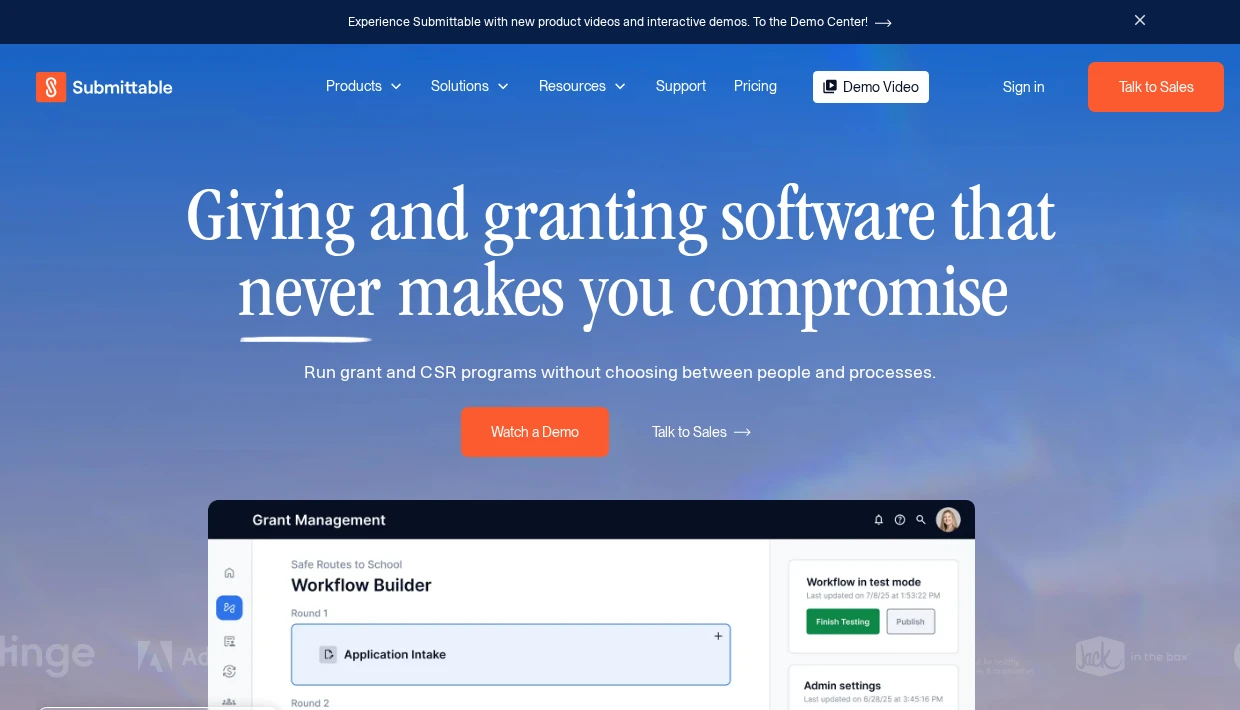
Most customers are happy with it. G2 rates Submittable 4.5 out of 5 across 168 reviews with strong marks for ease of use, and the platform carries a 4.8 out of 5 on Capterra across 398 reviews. Submittable's StoneX customer story describes a four-week implementation for an employee giving and volunteering program with no program downtime.
Why corporate teams look elsewhere
Submittable covers a lot of ground, but corporate and foundation giving teams tend to hit friction in a few specific places as their programs grow:
- Pricing is quote-only at every tier. Submittable offers three plans (Corporate Social Responsibility Platform, Grant and Application Management, and Enterprise) and publishes no pricing for any of them. A program lead can't size the budget case without a sales conversation first.
- Key capabilities sit in the Enterprise tier. Submittable's pricing page lists funds distribution, custom integrations, and premium support and implementation under Enterprise. Teams on the lower tiers handle vetting and payouts through separate workflows or outside tools.
- A multi-audience roadmap means shared priorities. Submittable serves government agencies, foundations, and corporations on the same platform, so corporate giving teams share a development roadmap with two other buyer types. Feature requests compete for attention.
- Support friction shows up in reviews. Some G2 reviewers report difficulty getting timely help. One described their support rep as "virtually nonresponsive," and another said they regularly experience glitches and have trouble reaching technical support.
- Implementation runs about two months. G2 lists Submittable's average time to implement at two months. That's faster than enterprise platforms like Benevity or Blackbaud, and slower than self-serve platforms like Uncommon Giving, where launch can happen in as quick as 48 hours.
Submittable alternatives at a glance
Here's how the five alternatives compare on the dimensions that matter most for corporate grants teams. Ratings were pulled from G2 and Capterra in September 2026 and pricing from vendor sites where published.
| Alternative | Best for | Rating | Pricing |
| Foundant Grant Lifecycle Manager | Foundations that need grants plus fund accounting | 4.9/5 Capterra (52 reviews) | $6,500 to $13,900 per year, implementation from $2,500 |
| Blackbaud Grantmaking | Enterprise grantmakers with complex portfolios | 3.9/5 G2 (40 reviews) | Custom quote |
| Uncommon Giving | Corporate teams running grants alongside employee giving and matching | 4.9/5 Capterra (18 reviews) | Grants management from $2,400 per year; implementation starts at $0 |
| SurveyMonkey Apply | Teams that want maximum workflow flexibility | 4.4/5 G2 (43 reviews) | Tiered by application volume, not published |
| Good Grants | Lean teams running a single grants or awards program | 4.5/5 G2 (90 reviews) | From $3,950 per year |
How we researched Submittable alternatives
We're one of the platforms in this comparison, so an even-handed evaluation mattered more than usual. Here's how we approached it:
- Pulled ratings and review counts from G2 and Capterra for every platform, including our own, in September 2026.
- Verified pricing against vendor sites where it's published (Foundant, Good Grants, and Uncommon Giving), and marked the rest as quote-only.
- Gave our own section the same strengths-and-limitations structure as every other option.
Disclosure: Uncommon Giving publishes this blog and is one of the five platforms reviewed below.

5 Submittable alternatives by use case
Each platform below is scoped to grants and social impact use cases. Literary submission tools and competition-judging products are out of scope.
1. Foundant Grant Lifecycle Manager: best for foundations that need grants and fund accounting together
Foundant's Grant Lifecycle Manager handles the full application cycle for foundations that also need fund accounting and donor records in the same back office. With 2,300 or more client foundations and a published 94% renewal rate, it's the established choice in its segment.
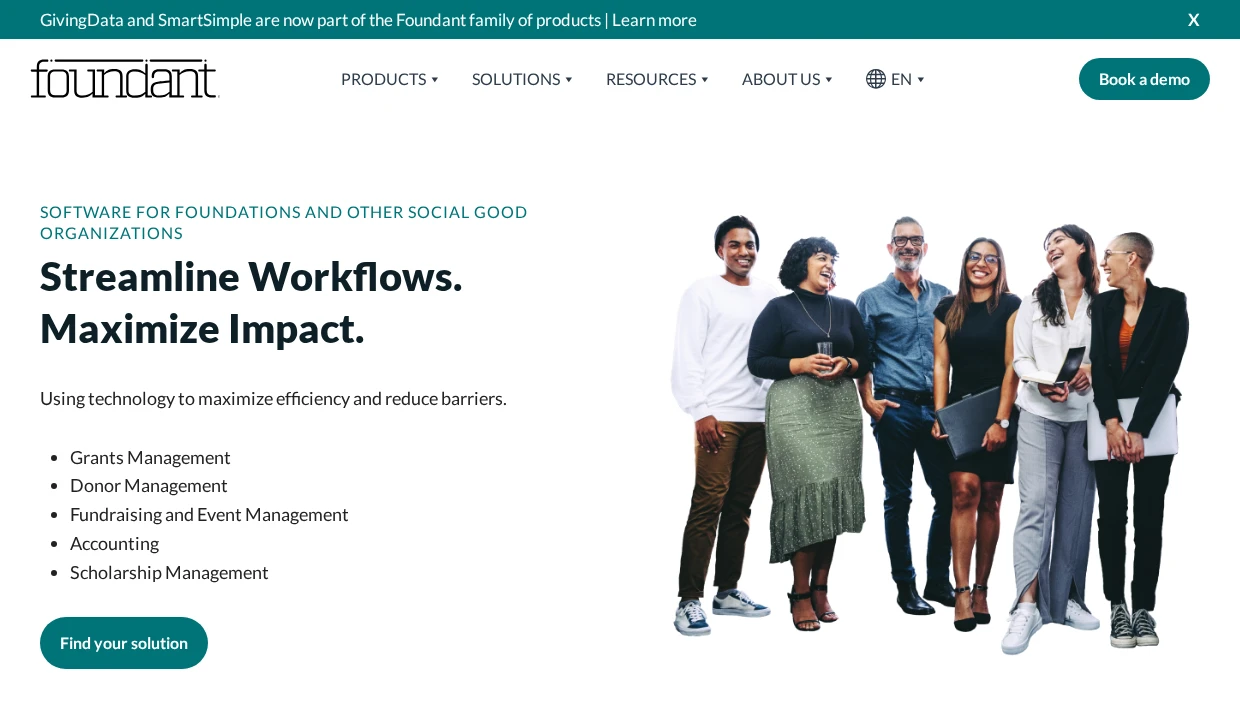
Best for: private and community foundations running scholarships and fund accounting alongside grants.
Key features
- Branching application forms with eligibility quizzes
- Online scoring with AI-generated application summaries for reviewers
- Real-time reporting
- Financial tracking synced with QuickBooks Online and Foundant's CommunitySuite
- Compliance and audit-trail tools built around IRS Form 990 documentation
What we like
- Transparent pricing with three published tiers.
- Strong fit for organizations that need grants, scholarships, and fund accounting in one vendor relationship.
Watch out for
- Volunteering, employee giving, and matching live outside the product, so a corporate team that wants everything in one place still needs a second platform.
- Foundant and SmartSimple announced a merger in August 2024. Both products continue to operate, but it's worth understanding the ownership structure, since roadmaps can shift after mergers.
Pricing: $6,500 (Basic), $9,900 (Standard), and $13,900 (Advanced) per year, with implementation fees from $2,500 to $4,500 by tier.
Reviews: 4.9/5 on Capterra (52 reviews).
2. Blackbaud Grantmaking: best for enterprise grantmakers with complex portfolios
Blackbaud Grantmaking (formerly MicroEdge GIFTS) is the enterprise end of this category. It's built for organizations managing large, multi-year grant portfolios where financial governance matters more than setup speed.
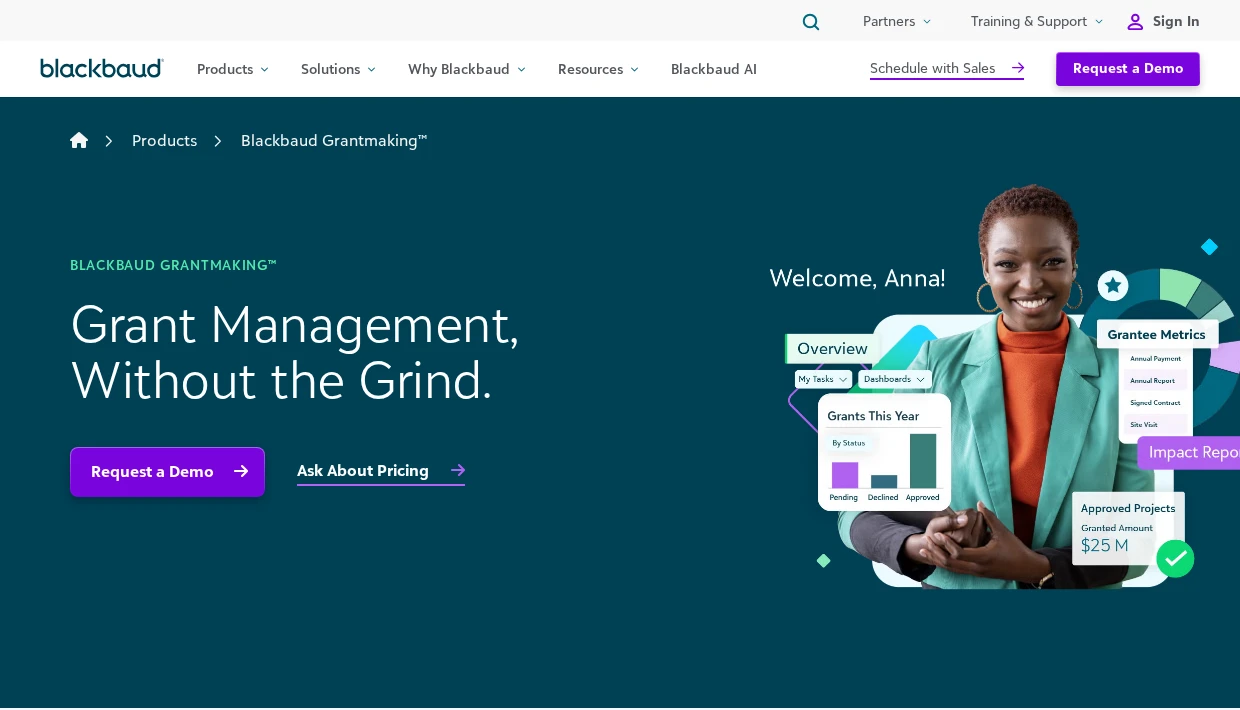
Best for: large foundations and corporate foundations already running on Blackbaud's fundraising or financial products.
Key features
- Multi-stage workflows for intake, review, and award
- Integration with Blackbaud's broader fundraising and financial ecosystem
- Portfolio and pipeline reporting across large grant volumes
- Compliance and audit tools built for regulatory scrutiny
What we like
- A financial control layer built for organizations moving serious grant volume across multiple programs.
- A deep track record in the philanthropic sector.
Watch out for
- Implementation resembles an enterprise software rollout more than a self-serve setup. G2 lists the average time to implement at three months.
- Pricing requires a sales conversation.
- Employee giving, matching, and volunteering sit outside the grantmaking product.
Pricing: custom quote.
Reviews: 3.9/5 on G2 (40 reviews).
3. Uncommon Giving: best for corporate teams running grants alongside employee giving
We connect corporate grantmaking to employee giving and matching and volunteering on a single nonprofit record. That addresses the specific reconciliation problem a corporate team inherits when grants run in one tool and the giving program runs in another.

Best for: CSR and community investment teams at companies of 10,000 employees and under that want grants, giving, matching, and volunteering administered together.
Key features
- AI-drafted application forms matched to your scoring rubric, with every question editable
- Employee nominations grouped by organization and deduped by EIN, with conflict-of-interest disclosure captured up front
- Weighted scoring on a 1 to 5 scale, locked once the program publishes so criteria hold steady for the full cycle
- Funding pools tracked by department, fiscal year, and cause category with real-time balances
- Vetting against 1.8 million IRS-registered 501(c)(3) nonprofits, with reporting your finance team can export
What we like
- Grants, employee giving, matching, and volunteering share one nonprofit database and one admin dashboard.
- Nonprofit vetting and twice-monthly payouts come standard rather than gated to an enterprise tier, and Uncommon Giving charges 0% on grant dollars disbursed through its grants management product.
- Pricing is published. Grants management starts at $2,400 per year, employee giving and volunteering at $5,000 per year, and implementation starts at $0.
- Launch can happen in as quick as 48 hours, and the HRIS and payroll integration keeps the roster current without manual uploads.
Watch out for
- A newer platform than the legacy foundation-grade systems above.
- A large private foundation running complex fund accounting or a decades-old grant portfolio will find Foundant or Blackbaud a closer fit.
- A smaller review base than Submittable.
Pricing: grants management from $2,400 per year; employee giving and volunteering from $5,000 per year; implementation starts at $0.
Disbursement: twice monthly.
Reviews: 4.9/5 on Capterra (18 reviews).
4. SurveyMonkey Apply: best for teams that want maximum workflow flexibility
SurveyMonkey Apply is a general-purpose application and review platform that a team can shape into a grants program with enough configuration time. It answers the workflow-rigidity complaint some Submittable users raise, though it inherits the same generalist trade-offs.
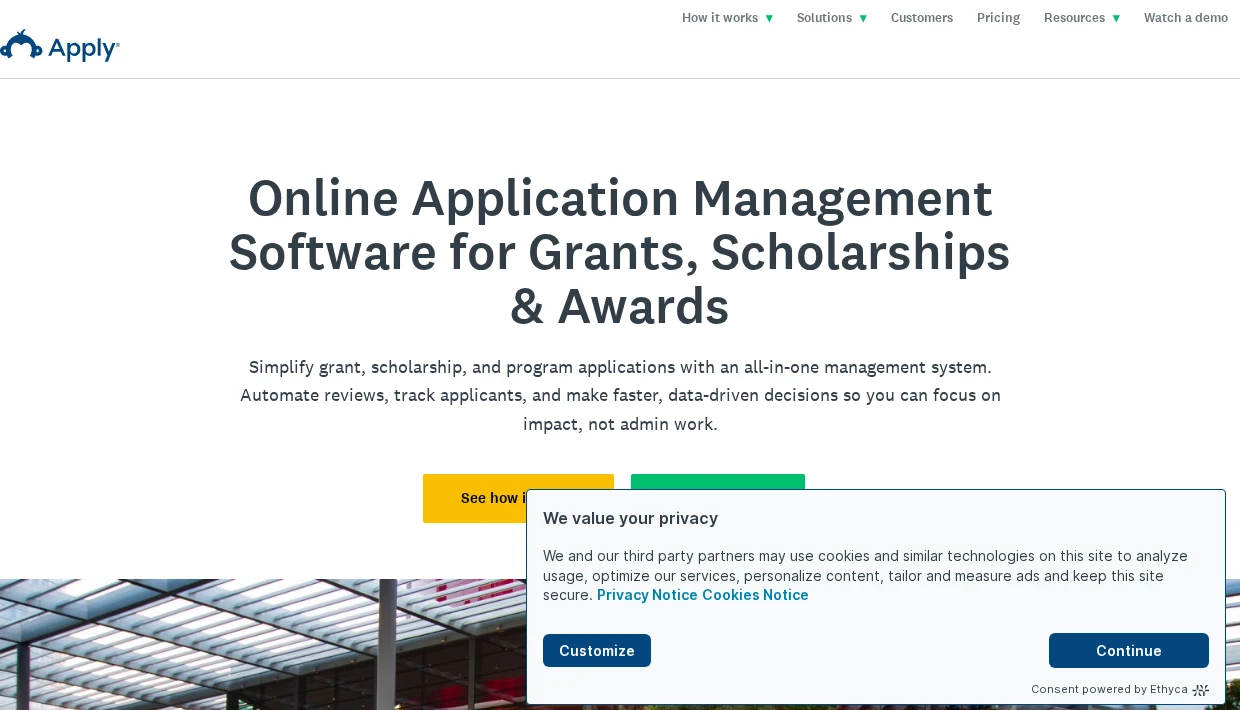
Best for: teams with an unusual review process who are willing to build it themselves.
Key features
- Dynamic, conditional application workflows and custom forms
- Multi-stage review and scoring
- Integration APIs for connecting to other systems
What we like
- Broad global reach and flexible workflow logic.
- A team with an unusual review process can usually build that exact process here.
Watch out for
- Initial setup is complex, and the most configurable tiers carry the highest prices.
- Pricing scales with application volume, which can get expensive quickly for a busy program.
- It's a generalist tool, so nonprofit vetting and giving-program integration happen outside the platform.
Pricing: tiered by application volume, not published.
Reviews: 4.4/5 on G2 (43 reviews).
5. Good Grants: best for lean teams running a single program
Good Grants is built for small grantmaking or awards programs, and its pricing transparency is the standout. Anyone can see the price, start a 14-day trial, and configure the platform without a sales cycle.
Best for: a one- or two-person team running a single annual grant or awards round.
Key features
- Grant and award program management with automatic and manual scoring
- Choice of hosting region
- Application intake, management, and review at a published price
- Post-award tools to collect grant reports and manage disbursements
What we like
- Clear, structured workflows that keep a small program organized.
- Unlimited users on every published plan.
- A lean team can configure the platform without heavy customization work.
Watch out for
- Some customers find the platform difficult to navigate.
- The structure that helps a small program can feel rigid as the program grows, and reviewers running a single annual round question paying for a year-round subscription.
Pricing: $3,950 per year (Intro), $7,900 per year (Premium), Enterprise by custom quote.
Reviews: 4.5/5 on G2 (90 reviews).
How to choose the right Submittable alternative
The right platform depends on your program's shape more than any single feature. Three steps get you to a shortlist.
- Start with the friction pushing you off Submittable. If it's compliance documentation and fund accounting, look at Foundant or Blackbaud. If it's running grants and a giving program as two disconnected systems, look at a unified platform like ours. If it's cost visibility on a small program, Good Grants publishes its pricing.
- Check third-party reviews. G2, Capterra, and TrustRadius carry filtered views for reviewers who switched from a specific product. Note which ratings are independently sourced and which are self-reported. This comparison uses independent review sites for every vendor, including us.
- Run a real grant cycle through the demo. Use one of your own applications, route it through your real reviewer group, and check whether the scoring output matches how your committee decides. Free trials are rare in this category, which makes a structured demo with your own data the practical substitute.
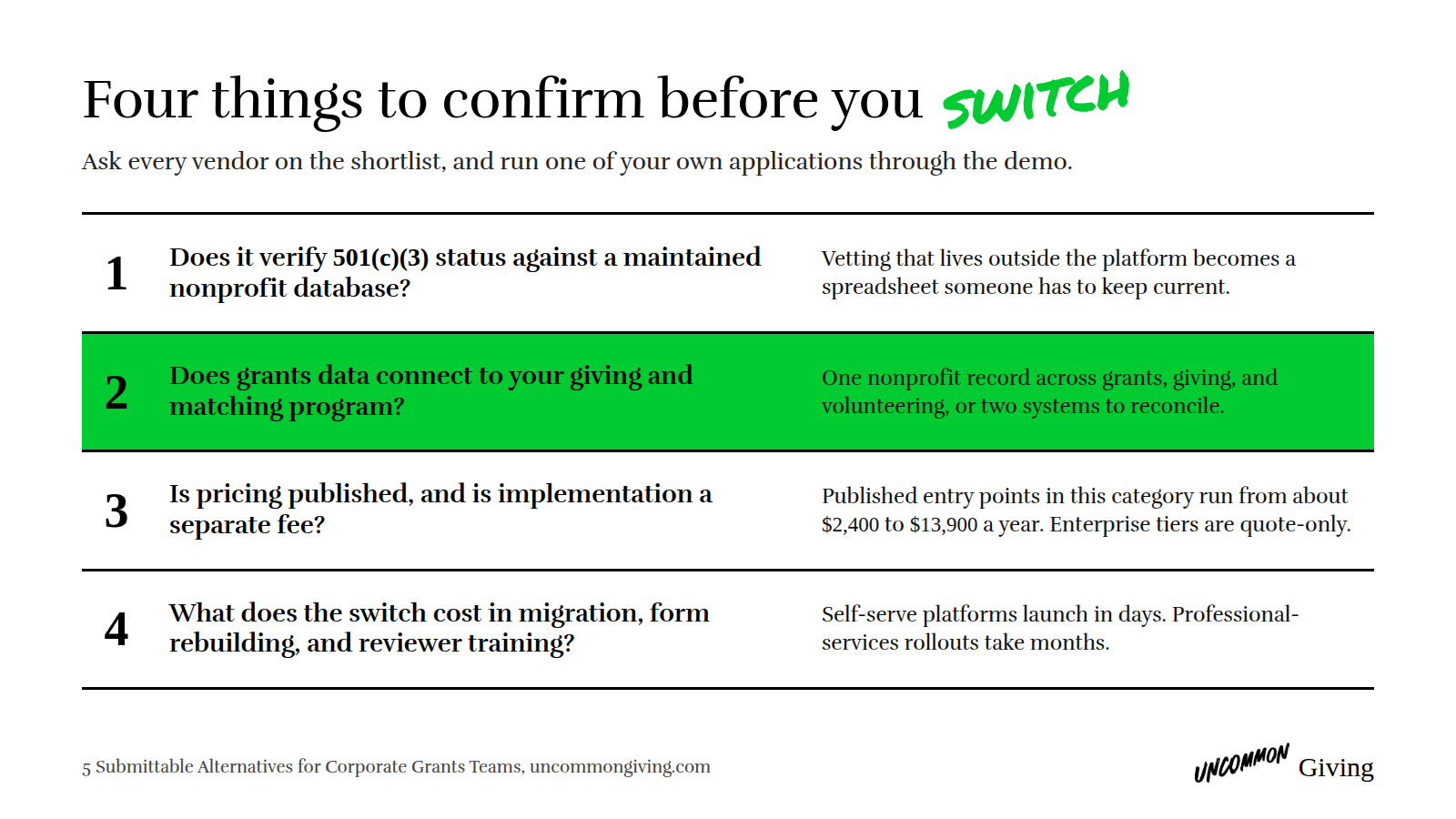
Before you migrate, confirm four things: whether the platform natively verifies 501(c)(3) status against a maintained database, whether it connects grants data to any existing giving or matching program, how transparent pricing is and whether implementation carries a separate fee, and what the switch requires in data migration, form rebuilding, and reviewer training. Our ROI calculator can put your own headcount and grant volume against those costs.
Choosing your corporate grants management solution
If your team runs grants alongside a broader employee giving program, or wants to, a platform built to unify both is worth a direct look among the Submittable alternatives above. We connect corporate grantmaking to employee giving, matching, and volunteering on one nonprofit record, with vetting against 1.8 million verified 501(c)(3) nonprofits and twice-monthly disbursement included. Grants management starts at $2,400 per year and implementation starts at $0.
Request a demo to see how AI-drafted applications, weighted scoring, and budget controls work against your actual program, or read how other teams run it in our case studies. If you're weighing the wider field, our guides to CSR software and corporate giving software and the comparison pages cover the rest of the market.
Frequently asked questions about Submittable alternatives
Why do corporate teams outgrow Submittable?
Corporate CSR teams typically outgrow Submittable when their program needs more predictable pricing as it scales, deeper integrations with HRIS or financial systems, or a unified platform that connects grants with employee giving and volunteering.
How much does corporate grant management software cost?
It varies widely. Published pricing in this category ranges from $2,400 to $13,900 per year, and enterprise platforms are quote-only. Uncommon Giving grants management starts at $2,400 per year with implementation starting at $0.
What should I look for when switching grant management platforms?
Four things. Does the platform natively verify 501(c)(3) status against a maintained database? Does it connect grant data to any existing giving or matching program? How transparent is pricing, and does implementation carry a separate fee? And what does migration require in form rebuilding and reviewer training?
What's the difference between a submission platform and a grants management platform?
A submission platform handles intake and review across many use cases, from literary magazines to scholarships to grants. A grants management platform is built specifically around the grantmaking lifecycle, with budget tracking, disbursement, nonprofit verification, and compliance reporting built in rather than configured on top.
How long does it take to switch grant management platforms?
It depends on the platform. On a self-serve platform like Uncommon Giving, launch can happen in as quick as 48 hours. Enterprise platforms with professional services engagements typically take two to six months. The main variable is whether the platform requires custom configuration or supports self-serve setup.
Can I integrate grant management with employee giving and volunteering?
Some platforms keep grants, giving, and volunteering in one system with a shared nonprofit record. Others handle grants only, which means running a second platform for employee giving and reconciling across both. If your company runs both programs, ask whether they share data or require separate administration.
Related articles
- 11+ best CSR software for impact, engagement, and ROI. Twelve platforms compared on giving, volunteering, matching, and reporting.
- 10+ best corporate giving software for easy social impact. The wider field of platforms, with pricing and trade-offs for each.
- Donation matching for companies: a complete program guide. Ratios, caps, and policy design for a match program employees actually use.
- Employee and workplace giving: blueprint for modern companies. How to design a giving program from policy to launch.
- Payroll giving: a practical guide for HR leaders. How payroll deductions, matching, and giving wallets fit together.