
Search "csr reporting software" and most of what comes back is ESG and sustainability compliance content written for investors and regulators. That is a different job for a different reader. If you run workplace giving, matching, volunteering, and grants, your reporting audience sits inside the building with you, in the leadership team and the employee base.
This guide covers what CSR reporting software is, why the pressure on these teams is rising, how to evaluate options, and what reporting looks like when every program runs on one data source. If you are still deciding what a report should include and who it is for, start with our guide to CSR reporting.
Key takeaways
- Know what the category covers. CSR reporting software tracks and communicates your giving, matching, volunteering, and grants activity to leadership and employees, with no regulatory disclosure framework attached.
- Rule out the wrong category early. ESG compliance suites answer to investors and regulators through standardized disclosure frameworks, which is a separate purchase from workforce program reporting.
- Expect more reporting demand than headcount. CSR teams report rising internal visibility and more pressure to connect programs to business outcomes, according to ACCP's 2025 survey.
- Evaluate on four dimensions. Reporting depth, integration breadth, ease of use, and cost relative to scope separate a credible platform from a spreadsheet with extra steps.
- Ask where the data originates. When giving, matching, volunteering, and grants run in one system, the reconciliation step that creates errors and delay disappears.
On this page
- What is CSR reporting software?
- Why CSR and People teams need this now
- What core features does CSR reporting software include?
- How to evaluate CSR reporting software
- The CSR software vendor landscape
- How real-time reporting works in practice
- Frequently asked questions about CSR reporting software
What is CSR reporting software?
CSR reporting software is a platform that centralizes a company's giving, matching, volunteering, and grants activity and turns it into reports for leadership and employees. It collects transactions as they happen, tracks participation and spend, and generates reports leadership can use to make decisions. Corporate social responsibility describes the broader business practice, and CSR reporting software covers the measurement and communication layer underneath it.
The boundary with ESG software is about audience and requirement. ESG and sustainability compliance suites are built around standardized, externally regulated disclosure frameworks such as carbon accounting, CSRD, and ISSB-grade reporting. Those platforms exist to satisfy an external requirement. CSR reporting software exists to show your own people what your programs did.
The line blurs partly because the market is still forming. Grand View Research puts the CSR software market on a 10.5% compound annual growth rate through 2033, and vendors from adjacent categories keep reaching into it. Impact reporting sits inside the category as a deeper layer, mapping program inputs to outcomes so a grant amount translates into meals served or scholarships funded. That outcome layer is usually what leadership means when they ask how the program is doing, and our guide to social impact measurement covers it in depth.
Why CSR and People teams need this now
The scrutiny on CSR work has gone up. ACCP's 2025 CSR Insights survey found 62% of CSR professionals reporting increased internal visibility and 51% being asked to more clearly connect their programs to business outcomes. Visibility is useful right up until someone asks for the numbers on short notice.
Responsibilities expanded faster than teams did. The same survey found 72% of CSR professionals reporting expanded responsibilities. A one-person CSR function can hand-assemble a quarterly report for a 600-employee giving program. At 3,000 employees, with matching, volunteer hours, and grants in the mix, that approach stops working, and the reporting cycle becomes the limit on how often leadership sees anything at all.
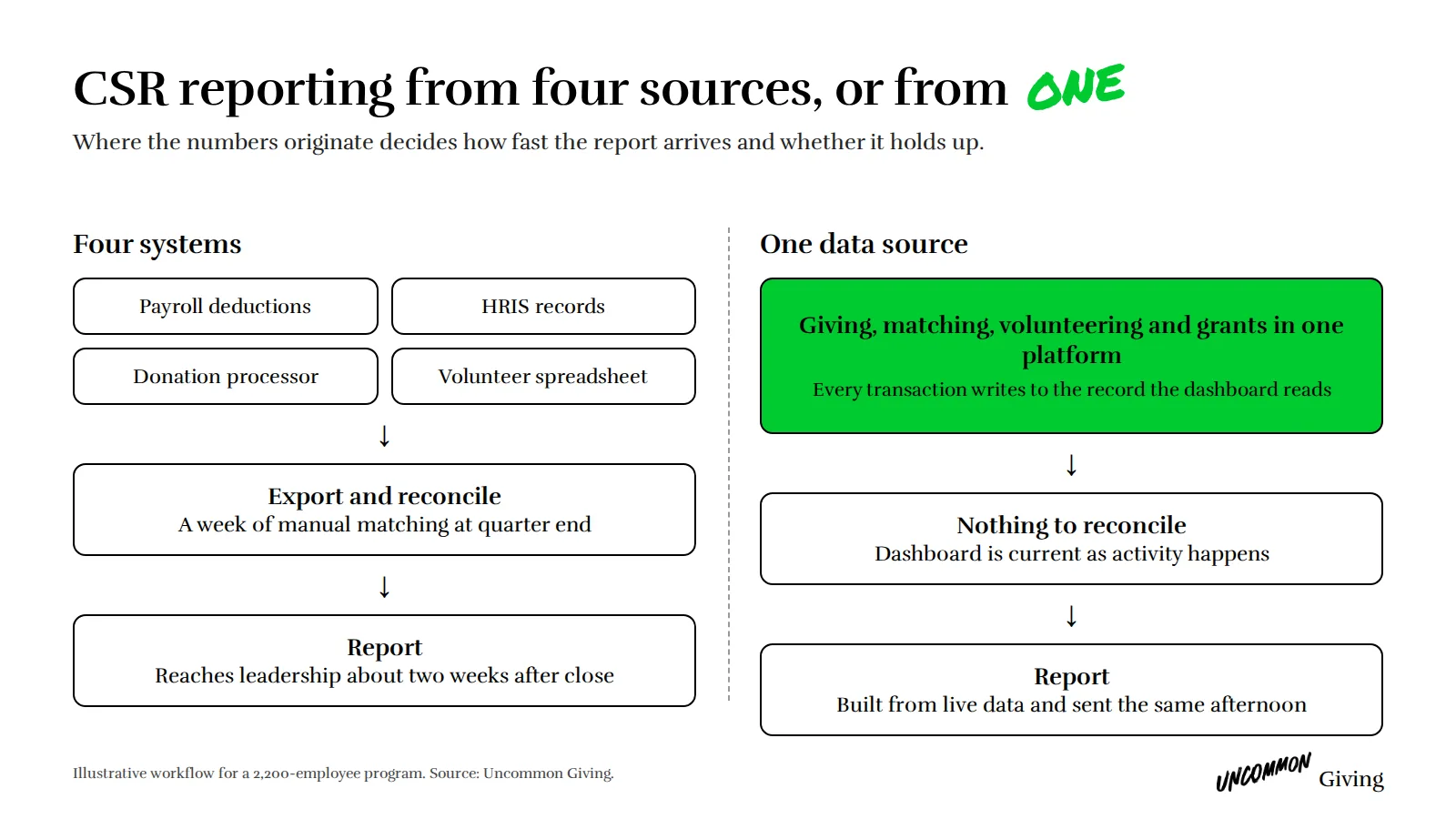
The data is scattered by default. Payroll holds the deductions, the HR platform holds employee records and eligibility, and a donation processor holds the transactions. Volunteer hours and grant approvals often live in a spreadsheet someone maintains by hand. Quarter end becomes a reconciliation project across four sources before a single slide gets built.
Two audiences need two things from the same data. Leadership wants a narrative they can carry into a board meeting or a budget conversation. Employees want to see what the company did together and where their own participation landed. Both depend on numbers that hold up.

What core features does CSR reporting software include?
Real-time dashboards replace the export-and-reconcile cycle. A quarterly pull tells you what happened three months ago. A live dashboard shows donation totals, match spend, participation rates, and top causes as employees generate them, so a question from your CFO in week six of the quarter has an answer in week six.
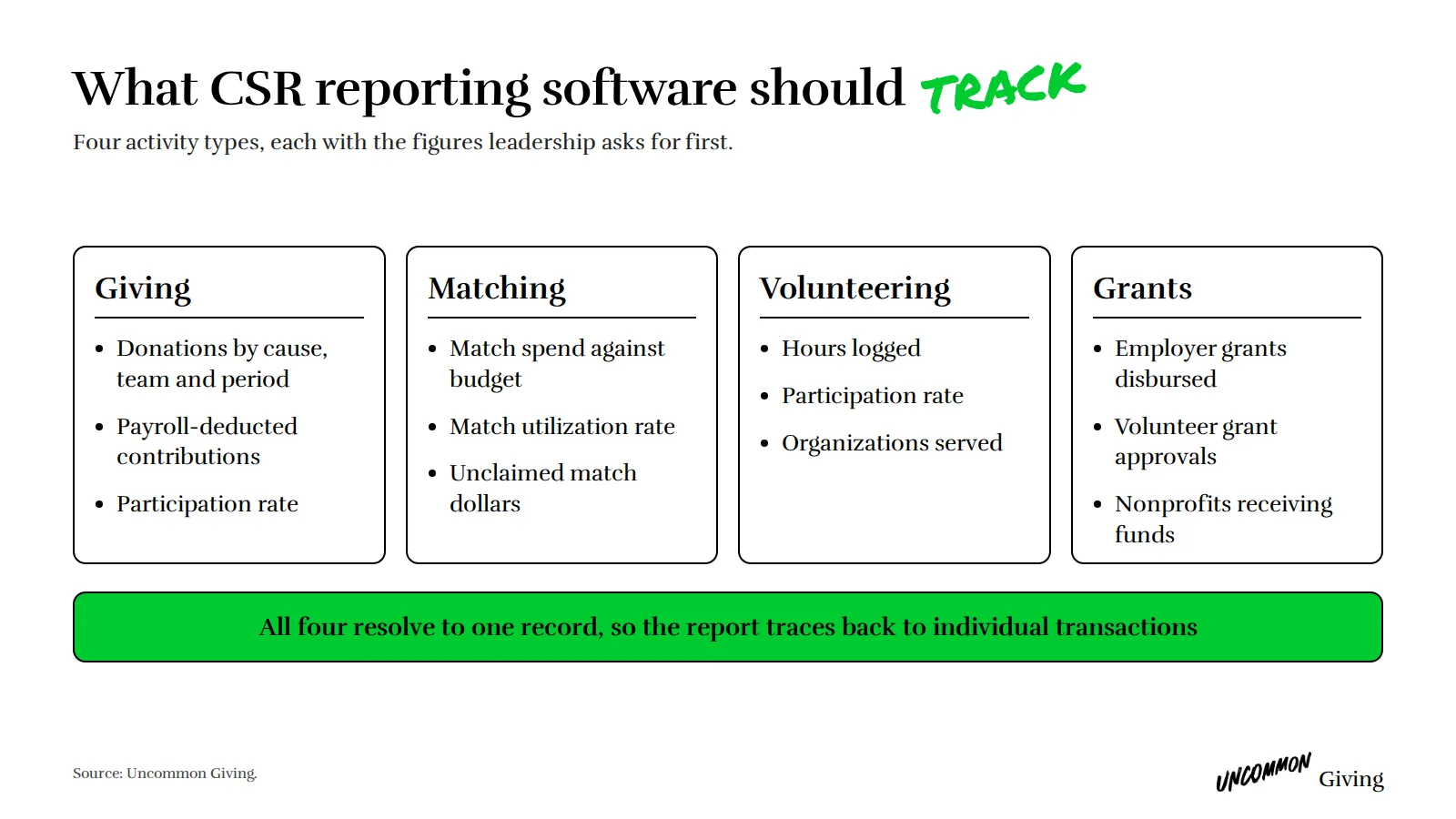
A credible platform tracks four activity types. Check any option you evaluate against this list:
- Giving. Employee donations by cause, by team, and by period, including payroll-deducted contributions.
- Matching. Match spend against budget, match utilization rates, and unclaimed match dollars.
- Volunteering. Hours logged, participation rates, and the organizations where employees served.
- Grants. Employer grants disbursed, volunteer grant approvals, and the nonprofits receiving them.
Payroll and HRIS integration is the mechanism behind automated capture. HRIS and payroll integrations move employee and payroll data between systems without manual entry. For CSR reporting software, that means a payroll-deducted donation and its employer match land in the report the moment the transaction clears. Ask every vendor how that connection works.
Match calculation accuracy is a reporting question as much as a finance one. Match rules carry eligibility criteria, per-employee annual caps, nonprofit restrictions, and request windows, and errors in any of them accumulate quietly in both directions. Over-matching creates financial exposure, and under-matching erodes employee trust.
Uncommon Giving's matching engine is CLMA certified. CLMA stands for Certified Leader in Matching Automation, a certification Double the Donation awards to platforms that support matching gift auto-submission, and several platforms hold it. It is worth screening for because unclaimed matches are mostly a paperwork problem. Separately from the certification, every match transaction writes to the same record the reporting dashboard reads, so the figures in a report trace back to individual transactions.
Outcome mapping turns activity data into a leadership-ready narrative. It translates a dollar contributed, an hour volunteered, or a grant disbursed into a plain-language result, like a grant funding a set number of meals. That needs its own measurement layer, and it is the difference between reporting "we gave $50,000" and reporting what that $50,000 accomplished.
How does Uncommon Giving structure its CSR reporting?
The reporting dashboards read from the same live data the transactions created, surfacing donation totals, match spend, participation rates, and top causes in real time. Giving, matching, and volunteering run inside one application, so a payroll deduction, its employer match, and the volunteer hours behind a grant request all write to the record the dashboard displays.
Each employee holds a personal donor-advised fund inside that application, which is where donations originate, so participation counts come from actual account activity. The CSR Impact Report Builder sits on top of that data as the narrative layer, a structured template a CSR lead fills and exports when leadership wants the story behind the figures.
How to evaluate CSR reporting software
Four dimensions separate credible CSR reporting software from a spreadsheet with a nicer interface. Weigh them against your program's actual size and your team's actual capacity.
| Criterion | What to ask the vendor | Warning sign |
| Reporting depth | Show me an actual report with outcome mapping, and tell me whether the export drops into a board deck without rework. | The demo only ever shows dashboard screenshots |
| Integration breadth | Which of our HRIS and payroll systems do you connect to, and how do donations and matches capture automatically? | Any system it cannot reach becomes a manual entry point |
| Ease of use | Can our CSR or People lead build a new report without a support ticket or IT time? | Report changes need a specialist |
| Cost relative to scope | What does a company of 100 to 10,000 employees pay, and what is the implementation scope and fee? | No published price and three to six months of professional services before the first report |
For a reference point on cost, Uncommon Giving publishes its rates: employee giving and volunteering starts at $5,000 a year with reporting included, and grants management starts at $2,400 a year.
Plan for more than one signature. The CSR or People lead usually drives the need, HR or Finance weighs cost and integration, and an executive sponsor cares most about the leadership-ready output. Finance in particular will ask whether you can produce an auditable record of every match transaction from past years, which is worth confirming before the demo. On Uncommon Giving, match transactions export from the reporting dashboard at the individual-transaction level.
The CSR software vendor landscape
The CSR reporting software market spans several platform types. Dedicated employee giving and volunteering platforms focus on workforce programs and the reporting that comes out of them. Broader social impact suites add adjacent program types such as grantmaking or community investment, though several were assembled through acquisition and their reporting layer reflects that history. Point tools cover a single capability such as supplier ratings or carbon tracking, and they show up in this category's search results while serving a different buyer.
For a platform-by-platform view, see our guide to the best CSR software for impact, engagement, and ROI. The right fit depends on which reporting job you have: workforce giving, volunteering, and grants reporting is one purchase, and compliance-grade disclosure for regulators and investors is another.
How real-time reporting works in practice
Uncommon Giving runs giving, matching, volunteering, and grants activity inside one platform, so the report reflects that activity as it happens. The dashboard and the transaction share a data source, which leaves nothing to reconcile between them.
Picture the before and after. A People and Culture lead at a 2,200-employee company spends the first week of every quarter pulling payroll deduction files, exporting donation records, chasing volunteer hours from a shared spreadsheet, and reconciling all three against the match budget. The report reaches leadership two weeks after quarter close, describing a program that has already moved. With a unified platform, the same lead opens a current dashboard, builds the narrative report from it, and sends it the same afternoon.
That shift changes what employees see, too. A live view of company-wide participation and top causes gives them something to look at year-round, and participation tends to follow visibility. It also changes what you measure. Total dollars disbursed is the number most teams report because it is the easiest to produce, but a program where 2% of employees account for most of the giving is fragile. Participation breadth is the stronger signal, and it becomes reportable once the platform tracks activity at the individual level.
To put a number on what a program is worth before you build reporting around it, try the ROI calculator, and the case studies show what three companies actually measured.

Frequently asked questions about CSR reporting software
What does CSR reporting mean?
CSR reporting means tracking and communicating your company's own giving, matching, volunteering, and grants activity to leadership and employees. It covers participation rates, dollars donated and matched, hours volunteered, and the causes supported. It is separate from public ESG disclosure, which reports standardized environmental and governance data to regulators and investors.
What is the best software for CSR or ESG reporting?
That depends on which category you need. If your job is reporting workforce giving, volunteering, and grants to internal audiences, evaluate CSR reporting software on reporting depth, integration breadth, ease of use, and cost relative to scope. If your job is regulatory disclosure under a framework like CSRD, you need an ESG compliance suite, and the two rarely come from the same vendor.
Where can I find CSR reports?
Inside your platform. CSR reports typically live in the reporting dashboard or report builder, where the data updates continuously. Teams share them internally as a dashboard view or an exported summary, and many companies publish a condensed version for employees, candidates, or a board audience.
How much does CSR reporting software cost?
It varies by category, and the entry price is often not the price of the program you want. Uncommon Giving includes reporting in every plan, with employee giving and volunteering starting at $5,000 a year and grants management starting at $2,400 a year, and implementation starts at $0. Enterprise ESG compliance suites are a different purchase and generally quote per account after a discovery call.
Do we need to switch our whole tech stack to get better CSR reporting?
No. HRIS and payroll integration exists so a reporting platform can pull from the systems you already run. Your payroll provider stays, your HR platform stays, and the CSR platform reads employee and deduction data from them. Confirm that connection early in any evaluation.
What is the difference between CSR reporting software and impact reporting?
Impact reporting is the deeper layer inside the same category. CSR reporting counts activity: dollars given, hours volunteered, participation rates. Impact reporting maps those inputs to outcomes, so a grant becomes a number of meals served. Outcome mapping needs its own measurement layer, so ask specifically whether a platform does it rather than assuming it comes with the dashboard.
Choose CSR reporting software built on one data source
You now know what the category covers, why the pressure on your team is rising, and which four dimensions to evaluate CSR reporting software against. The remaining question is where your numbers come from, because that decides whether your report is a record or an estimate.
Uncommon Giving gives CSR and People teams a real-time reporting view built on unified giving, matching, volunteering, and grants data, with the CSR Impact Report Builder turning that data into a leadership-ready narrative. Employee giving and volunteering can launch in as quick as 48 hours and a grants program takes about two weeks, with implementation from $0 and no professional services engagement. Your team skips the quarter-end scramble across four systems and the dedicated headcount that legacy platforms assume you have.
If you want to see your program's reporting without the manual assembly, request a demo and bring your current reporting questions.